
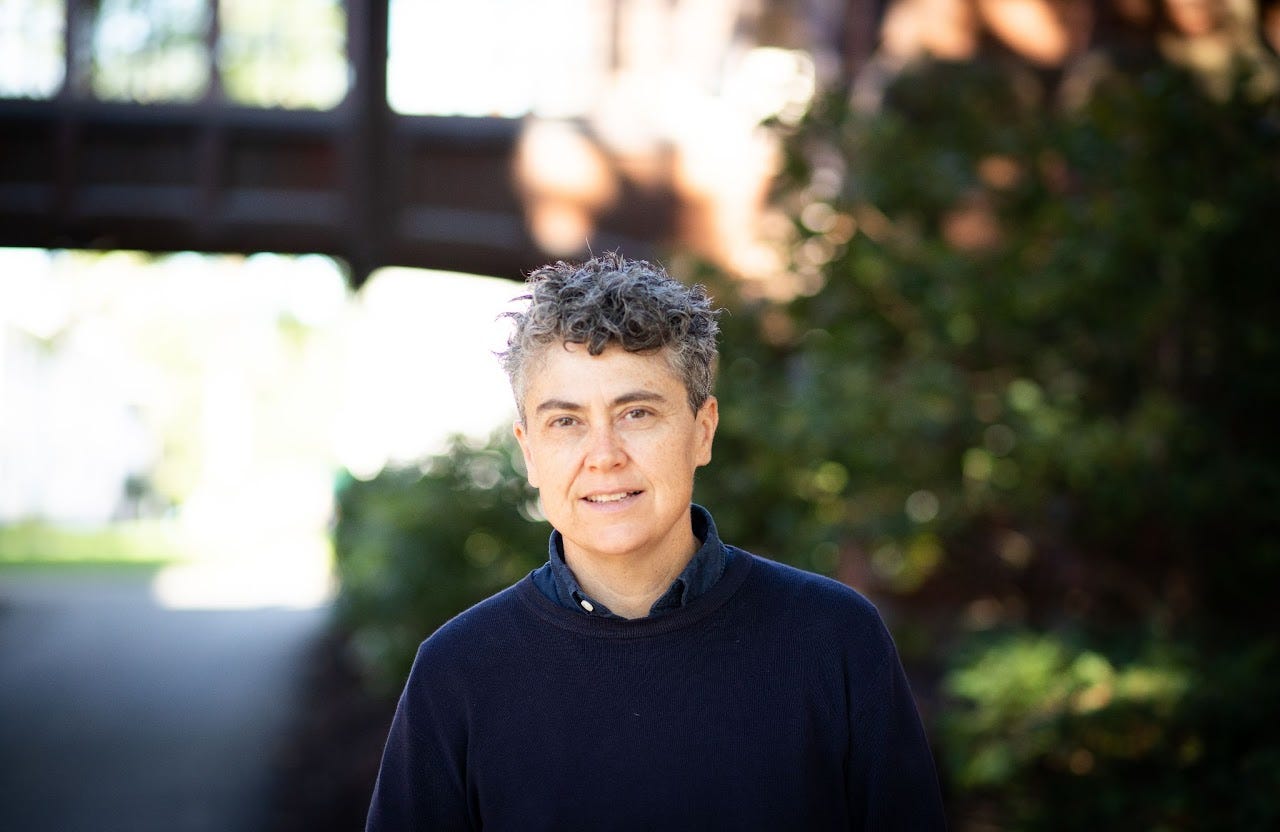
Andrea Lawlor is delighted that their book is thought dirty by the French. Laure Jouanneau-Lopez’s Francophone translation of their novel Paul Takes the Form of a Mortal Girl, published by La Croisée, has recently won the Prix Sade – an erotic literature award in homage to the noted libertine.
In Paul Takes the Form of a Mortal Girl, Lawlor created a protagonist at the intersection of queer identities. Paul is a shapeshifter, consistently using his power to become ever more gay – to manifest a bigger dick for the leather bar, or to become a riot grrl en route to the Michigan Womyn’s Festival. The book is deeply connected to character, engaged with theory and music and literary culture – and, yes, dirty.
We spoke to Andrea Lawlor about the novel, winning the Prix Sade, and the possibilities of sex writing.
Congratulations on winning the Prix Sade! How does it feel?
It was a total surprise. I’m so thrilled that the French publisher has been so behind the book, and I’m delighted with the translator’s work. Also, I think I was just really delighted to have been thought dirty by the French. It’s like a life dream achieved.
I’ve also been really entertained by who was following it. I went to a beautiful reading last week by Garth Greenwell, and he was like ‘oh, congratulations on the Prix Sade’ and I thought, oh yeah. You really know.
It does seem like something Garth Greenwell would be very tuned into. So, you said a little something there about the work of the translator. Are you involved in the process of translation at all?
Not at all. Actually, this is the first translation into any language of my novel, and I was so thrilled that a press wanted to do it. I have had many translators over the years. Oftentimes students, or, you know, independent translators, say like, ‘Oh, I’d really love to translate your book.’ And I’m like, ‘Yay, great. Go do that. My blessing.’
But it’s quite complicated. I don’t know how much you know about the translation world. But for the most part, the presses engage a translator, as opposed to the translator saying, I want to translate this. And so it’s a very different process. This translator seems great. I’m excited that they’re taking on questions of gendered language in the book, because I made some choices, and it’s interesting to see how it will play out in a different cultural context, and in a different language.
When you were writing the book, was this concept of moral constraint or libertinism something you were factoring in?
Not in the slightest. I mean, I read Sade in college because it was the 90s and that’s what one did, you know? I’m sort of like Sade, you know, not my fave of all the dirty French. I’m more of an Édouard Louis man, myself. But I think that Sade is an interesting figure to mobilise.
This idea of libertinism can mean a lot of different things, and I don’t love it when it’s in more of a straight context. But I did notice that Paul Preciado’s book has been awarded by this Prize, so they’re already engaging with queer and trans writing. I think there is something in me that recoils at the idea of libertinism. I don’t think my book is in favour of libertinism. But the idea that this prize, and the people involved, take sex writing seriously, feels like, you know - fellow travellers there.
I think sex is really interesting. I think it’s an interesting, subjective human experience. I think curiosity and flexibility and openness is sometimes called libertinism, or transgression of social norms that have historically been really oppressive can be called libertinism. It’s sort of like, if there’s this circle of what’s acceptable, the people who’ve been pushed to the margins oftentimes have common cause. Although, of course, not always. So, you know, it’s very cool to me that there’s a prize for work that thinks about sex, because that’s the baseline to me. I think that’s a good thing.
In a way, porn is kind of like the YA of sex writing. In YA, no matter what happens, it’s gonna be okay at the end, you know?
I recently taught a class on writing sex in fiction, and one of the students asked me my favourite question, which is: what’s the difference between porn and sex writing, sort of as ‘serious’ art? And I always sort of think, can it not be both beautiful and dirty?
Absolutely. I mean, sometimes I think that porn is, you know, functional, and a literary investigation of sex might produce an effect but it doesn’t necessarily have one aim. So maybe that’s the difference. Without saying anything bad about porn, it’s maybe just a little bit more like, what are the aims of the writing? A simplistic distinction might also be: in literary sex writing oftentimes the sex isn’t good, but it’s still interesting. And in a way, porn is kind of like the YA of sex writing. In YA, no matter what happens, it’s gonna be okay at the end, you know?
I do think a really interesting literary challenge is to write about sex that feels good and is satisfying in a way that’s hot. Garth Greenwell does it, and Melissa Broder – there’s a great scene in Milkfed where one woman is touching the other one’s hand in a movie theatre. It’s like the filthiest thing I’ve ever read. It’s fantastic.
Maybe less so now, but in the last five years or so there’s been a lot of these articles [on sex scenes] that were like ‘is this necessary? Do we have to see this?’
Like half the Goodreads – you’re not supposed to look at Goodreads but, you know, one does – and half of them for mine, all the one-stars, are like ‘too much sex.’
Just put the book down.
You can also just skim the sex scenes if you don’t like it. I mean, I don’t actually think that. I actually cut a lot of the sex scenes out of my book. I was like, is it moving the story along? Is Paul learning something? Is something affecting Paul in this scene that affects what else he does in the story? I think that’s a good metric. If you’re writing fiction that’s not meant to do just one thing, what is the sex scene doing for the story?
Sometimes it’s fine if it’s just sort of ambient, or character development, or wallpaper in some way. But if you’re really interested in sex, it’s sort of like – how does sex change?
I want to kind of circle back for a minute and go back to a little bit about the relationship between queer and trans writing and the right wing view of morality that’s really dominant at the moment. I noticed you said a bit about that in your statement on the Prix Sade.
We’re in this moment of such black and white thinking. In the United States, and I think it’s also happening in the UK, there’s this wave of ‘debate me’-style politics, ‘change my mind’, whatever. And it’s not onward leading. It’s not a way to truth or justice or happiness for anybody. It’s very combative, and I think it’s hard to have nuance in a context of such binary thinking.
You know, I don’t think oh, magical trans people can save the world and like, destroy fascism. I do think there’s something about queer people and trans people, where our existence allows for the reality of nuance in the conversation. We’re in such a weird, obvious time where the forces mobilised against us just don’t want us to exist. But we do exist. You can’t fight it, but they’re trying. It’s weird.
There’s this wave of ‘debate me’-style politics… And it’s not onward leading. It’s not a way to truth or justice or happiness for anybody.
Let’s return to Paul. I’m aware that it was quite a while ago now, because the book’s been out here in the UK for six years, and it was out in the US for a little while before that. But can you tell me a little bit about the actual process of writing the book?
I worked on it for a long time. I was rewriting Greek myth as a way to figure out how to tell a story, because I was like, I can’t make up a plot, what’s that? So I would have these Greek myths and sort of hang this thinly veiled autobiographical fiction on that skeletal structure. I was doing that, and I came up with this piece that ended up being the beginning of Paul. I put it away. I didn’t really do anything with it.
And then I was in a graduate programme, and I had to bring something to workshop and I was studying with Samuel Delaney at the time. And as people do in a workshop, I didn’t have anything that week, and I was scrabbling around for something old that I could bring in. I brought that in, and it was the first time that Samuel Delaney really paid attention to what I was doing. He was like, ‘I think you’re not done with Paul.’ And I was like, okay, whatever he says to do I will do. Then I spent the next 10 years finishing the novel.
I would work on it, and then stop working on it entirely for a year or something, and then come back to it. When I began writing it, I was sort of trying to explore through fiction things in my own experience that I hadn’t quite understood. Why do I keep thinking about that night? Why did I hook up with that person? Which is not to say that I am Paul, or that it’s completely autobiographical. As I started writing, I was really close to that experience. And as I kept writing, I got further and further away, to the point where my thesis advisor, Jed Berry at UMass, was like ‘I love all the historical fiction details’. I was like Jed, it’s not historical fiction. And now, the 90s do sort of feel like historical fiction.
One thing about the longer process of writing a book – writing it, putting it down, picking it back up – over 10, 12 years is that it kind of goes against that feeling that’s made worse here in the UK by so many prizes and schemes only being open to writers under 35, which is the pressure to rush something out, or to present a fully-formed work quickly and early on.
I think there’s a lot of weird age fetishising, and that has to do with author photographs. Capitalism is shot through all of it. The sort of paratext of the book is part of what sells the book, and younger people, you know, can be mobilised and objectified as something other than the makers of the work.
People should have space to take as long as they need. And I also think a lot of older writers have life experiences and don’t start writing until they’re older. A lot of people from marginalised communities, too.